Your organization, understood
Understand your Living Map
Explore how organizations develop shared understanding, then use the Living Map to follow objectives, relationships, evidence, and decisions in context.
Why Baekor?
People make better-informed choices when they can see what their organization is trying to achieve, where work depends on other teams, and what the evidence supports. This Guide starts with how organizations develop that understanding, then shows how to explore it in Baekor.
What you can explore
- Direction and responsibility
- Explore Objectives at different levels and inspect their owners, teams and organizational context.
- Dependencies and trade-offs
- Follow relationships to see how outcomes support, depend on or conflict with one another. Inspect their recorded meaning before drawing a conclusion.
- Evidence and interpretation
- Compare observations, sources and assessments. Ask what supports a claim, what is uncertain and whose interpretation you are reading.
- Choices and learning
- Inspect fictional scenarios, decisions, actions and learnings to understand how a situation can be considered and followed through.
Available in this pilot: browse the public model and its source records; with approved access, edit and save your separate Working Demo. The guide and demo work without AI.
The broader direction: help an organization develop from identity and intent through understanding, judgment, action and learning. The example records illustrate this journey; shared collaboration, automated execution and a complete approval workflow are not established by this pilot. AI is off.
Try the demo
Open the public North Star Company demo. No account is needed to explore it. Use one question throughout: What could affect enterprise revenue, and what evidence should we inspect?
- Start with the outcome. Keep Increase Enterprise Revenue as the Starting Objective. Read its description and owner in Focus on the right.
- Follow a connection. Select a connected Objective or relationship. Read its meaning in Focus and consider how it relates to the original outcome.
- Check the basis. In Collection on the left, explore Observations, Assessments and Sources and evidence. Distinguish recorded facts from interpretations and missing information.
- Explore another situation. Open Demo exercises on the left and choose a situation. Follow its steps; return to this guide when a concept is unfamiliar.
By the end, you should be able to explain one outcome, a relationship that matters to it, who owns it and what you would still need to check. That is the purpose of the demo: practising organizational understanding.
The public demo is read-only. Your approved Working Demo is a separate editable copy; changes there do not alter this public example.
Understanding Organizational Intelligence
An organization can have detailed reports and still miss a problem that is obvious to the people doing the work. One team sees a delay, another knows why the work is difficult, and a third controls the resources needed to respond. What matters is whether those people can bring their knowledge together, decide what the evidence supports, act on it, and learn from what follows.
Organizational Intelligence is the integrated capacity of an organization to establish coherence, develop understanding, act purposefully, and adapt continuously through the ongoing connection of awareness, experience, and knowledge.
Explore the organization, the four development aspects, the four integrated capabilities, and the eleven connected Experiences. The diagram remains still until you choose Play.
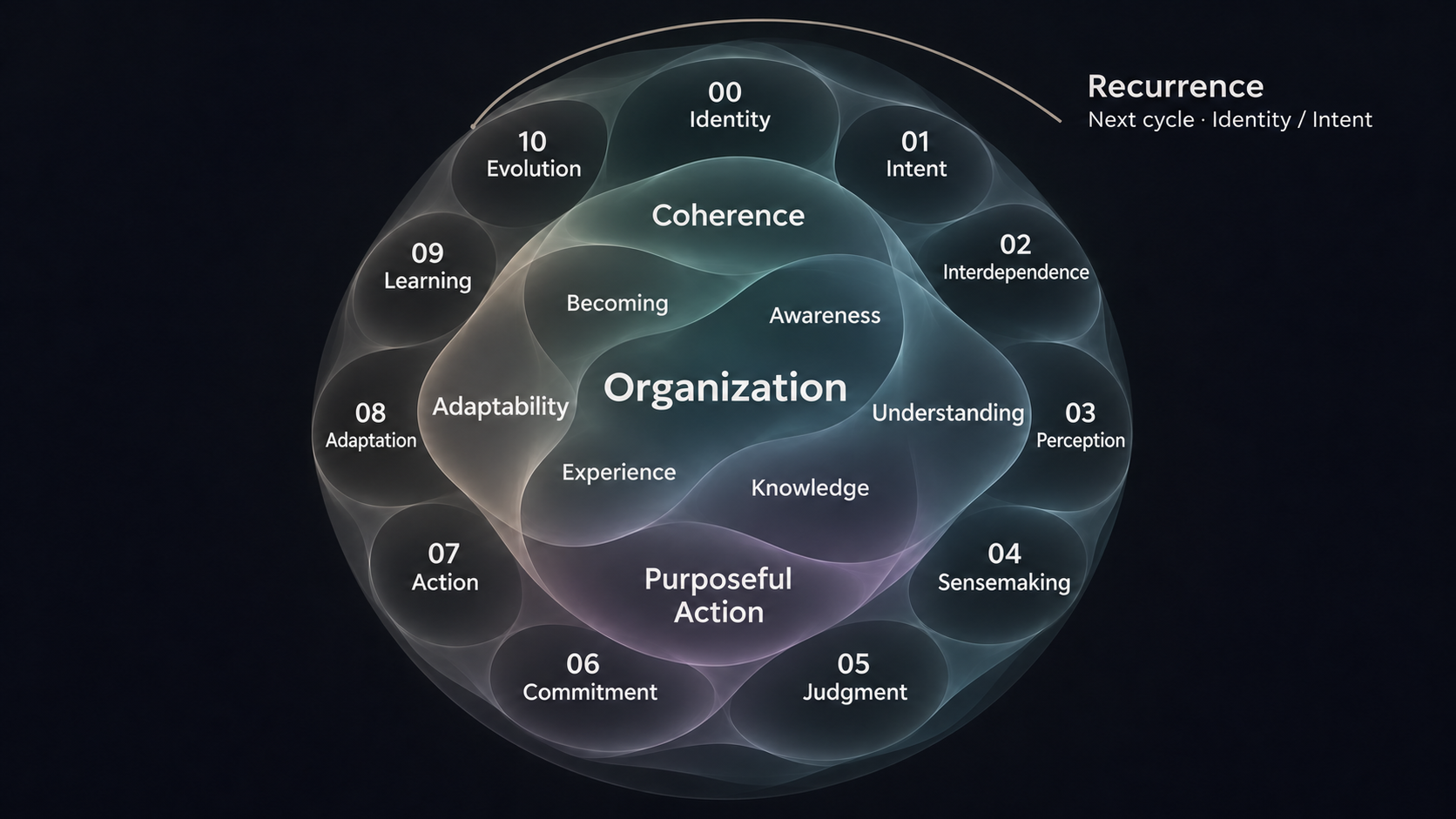
Current explanation
Ready to explore
Press Play to explore the development of Organizational Intelligence.
Read every animation phase as text
- Organization: Organizational Intelligence belongs to one living organization, not to disconnected modules.
- BAEK — Four Development Aspects: Becoming, Awareness, Experience and Knowledge are four intertwined aspects of organizational development, not four separate modules.
- Becoming: Organizations continually become; development is not a finished state.
- Awareness: Notice what is changing, missing or uncertain.
- Experience: Bring lived organizational context to what is observed.
- Knowledge: Retain and reconsider what has been examined, with its context.
- Organizational Intelligence — Four Integrated Capabilities: Coherence, Understanding, Purposeful Action and Adaptability describe what the organization develops through integration. They do not map one-to-one to BAEK.
- Coherence: Make connections and meaning consistent enough to act on.
- Understanding: Develop shared, explainable understanding across the organization.
- Purposeful Action: Turn accountable decisions into deliberate action.
- Adaptability: Respond to changing circumstances and revise what no longer holds.
- Development Journey — Eleven Connected Experiences: The eleven Experiences belong to one connected, non-linear Development Journey, rather than a sequence of finished steps.
- 00 · Identity: Who are we? The organization comes into being.
- 01 · Intent: Where are we going? The organization discovers its direction.
- 02 · Interdependence: How are we connected? The organization understands dependencies.
- 03 · Perception: What do we notice? The organization develops senses.
- 04 · Sensemaking: What does it mean? The organization creates shared meaning.
- 05 · Judgment: How should we evaluate? Evidence and alternatives remain distinct.
- 06 · Commitment: What do we commit to? Authority and ownership stay explicit.
- 07 · Action: What do we do? Deliberate action follows commitment.
- 08 · Adaptation: What needs changing? The organization responds to circumstances.
- 09 · Learning: What have we learned? Consequences invite further examination.
- 10 · Evolution: What changes next? Development opens further cycles of Identity and Intent.
- Recurrence: Development continues. Revisiting Identity and Intent is possible, but improvement is not guaranteed.
- Organic Dark · the whole: All emphasis settles into the original approved illustration, unchanged.
BAEK is Becoming, Awareness, Experience and Knowledge. The four capabilities emerge through their integration, not through a one-to-one mapping. The journey is interconnected and non-linear. The original image remains intact.
How organizations make sense of information
More information can make problems visible, but volume alone cannot tell people whether two teams measure the same thing, whether an explanation fits the evidence, or who can act. Awareness draws attention to changes and gaps. Experience gives people practical context for interpreting what they see. Knowledge preserves what has been examined and can be reused, within the circumstances where it holds. Each can correct the others. A new observation can challenge a familiar explanation, and a lesson from one team can help another notice a problem earlier.
The BAEKOR Framework
Becoming, Awareness, Experience, and Knowledge describe four interacting aspects of development within an Organization. Recurrence describes how the results of one cycle become part of the next.
- Becoming
- An organization is continually in development. Its identity, direction, capabilities, and ways of working shape what it can notice and do, and can themselves change through action and learning.
- Awareness
- People notice changes, dependencies, tensions, and gaps in their understanding.
- Experience
- People gain practical familiarity through participation, collaboration, choices, and their consequences.
- Knowledge
- People develop, test, retain, and reuse contextual understanding.
- Organization
- The living whole in which these four aspects interact. It includes people, teams, objectives, responsibilities, relationships, practices, sources, and their history.
- Recurrence
- Outcomes and learning create new context for the organization to revisit its assumptions, practices, relationships, and direction.
Four Organizational Capabilities
- Coherence
- See how purpose, objectives, responsibilities, resources, and dependencies fit together and where they create tension.
- Understanding
- Develop an evidence-grounded account of what is happening, what it may mean, and what remains uncertain.
- Purposeful Action
- Connect intent and judgment to an accountable choice, an explicit commitment, and coordinated work whose results can be observed.
- Adaptability
- Use outcomes, challenges, and learning to revise assumptions, priorities, responsibilities, and practices as circumstances change.
When two teams need the same specialist, Coherence makes the competing commitments visible. Understanding helps the teams check whether they estimated capacity on the same basis. Purposeful Action gives the chosen response an owner and a date. Adaptability uses the outcome to reconsider how the teams plan shared work. All four capabilities draw on the four aspects of development together, and each can change what the organization needs to understand next.
The Building Blocks of Organizational Intelligence
The capabilities become visible when people agree on an outcome, check what happened, choose a response, and examine the result. A fictional North Star service handover shows how those activities depend on one another.
Direction and structure
An Objective gives people a shared outcome to work toward and a basis for deciding what deserves attention. At North Star, improving service resilience is the Objective. Updating a shift roster is an Action that can contribute to it. The desired outcome helps people judge whether that work is worth doing and whether completing it made a difference.
A Relationship makes a dependency, contribution, or tension explicit. The recovery coordinator depends on Customer Support to name someone who can handle customer updates. Stating that dependency clarifies what each team is responsible for and where a capacity problem could matter. It gives people something to investigate when a handover fails. Establishing the cause of a failure takes evidence of its own.
Understanding organizational reality
Awareness draws attention to the missing contact. An Observation records what was noticed or measured in context. Evidence is the material that supports or challenges a claim about it. The exercise log supports the observation that the second shift began without a named Support contact. It leaves open whether nobody was assigned or an assignment was recorded late. Those are competing Interpretations. The narrower Conclusion is that coverage could not be verified in advance.
Understanding develops as people examine those distinctions using evidence and context. Experience from earlier handovers helps the coordinator recognize where verification tends to break down. The organization can retain reviewed understanding as Knowledge, with a record of where it came from and when it applies. If a dated assignment turns up, the team can reassess the conclusion, update what it knows, and reconsider a commitment based on the earlier account.
Making choices and acting
Judgment weighs options against the Objective and the likely consequences. A short trial of named backup coverage would let North Star check whether people could verify coverage before considering the cost of a new on-call rotation. That reasoning can guide the choice. The Decision comes when the authorized service lead approves the trial and records its purpose and scope.
Approval gives the trial authority. The Support lead’s Commitment identifies who will name the primary and backup contacts, for which shifts, and by when. Updating the roster is the Action that follows. Each record answers a different question about accountability, from who made the choice to who undertook the work and whether it was carried out.
Results, learning, and development
The observed Outcome was that coverage could be verified before both trial shifts. The completed roster records what the team did. The verification records what it could establish afterward. Finding out whether the change caused an improvement in recovery would require further evidence, including measures the trial did not collect.
Learning happens when people compare their expectations with what they experienced and observed, test their explanations, and revise understanding or practice. North Star carried a pre-shift check into its charter and Objective. That change gives the next exercise a different starting point. Learning may also uncover a mistaken assumption or leave a question unresolved. Through Adaptability, Evolution, and Recurrence, what the team learns can change what it notices, expects, and does next.
An Objective can align responsibilities, guide a choice, and give people a basis for adapting after they see the result. Evidence can clarify what happened and prompt a team to revisit a decision. These concepts work together across the Development Journey. The full North Star example follows the same reasoning in context.
How Organizations Develop
The Development Journey describes eleven Experiences in canonical order. They are connected perspectives on the same organization. A team may notice a problem while delivering work, revisit its judgment when evidence changes, and clarify its intent before taking action again.
Establish direction and see what it depends on
- IdentityEstablish who the organization is, where its scope lies, and how it understands its responsibilities.
- IntentClarify purpose, desired outcomes, and what success would look like.
- InterdependenceMake contributions, dependencies, influence, and tensions visible.
Notice, interpret, and weigh the evidence
- PerceptionRecord what was noticed or measured, in what context, and where it came from.
- SensemakingExamine patterns and competing interpretations to reach reasoned conclusions.
- JudgmentWeigh options against purpose, criteria, consequences, trade-offs, and uncertainty.
Follow through and reconsider what comes next
- CommitmentSpecify who undertakes what, by when, and with what capacity or conditions.
- ActionCoordinate work and observe execution, constraints, and outcomes.
- AdaptationAdjust priorities, resources, or practices in response to circumstances and evidence.
- LearningExamine experience and outcomes, test interpretations, and revise understanding or practice.
- EvolutionCarry learning into the organization’s capabilities, relationships, identity, and direction.
The concepts above stay connected across the Journey. A Conclusion can be revisited when the Outcome of an Action challenges it, and what people learn may change the next Objective. The four capabilities run through the Journey. Coherence helps make dependencies visible before and during action. Understanding informs judgment and is tested again by outcomes. Purposeful Action draws on both as people commit and deliver. Adaptability can bring the organization back to any Experience when evidence, responsibilities, or circumstances change.
Recurrence means that learning and evolution give the next cycle a different starting point. What the organization has learned may change its Identity and Intent, help it interpret a similar event, or prompt a different response. A cycle can also carry forward a mistaken assumption or an ineffective practice. Improvement depends on examining outcomes and acting on what the evidence supports.
Evolution may reshape Identity and Intent. New Evidence can also return the organization to Sensemaking or Judgment. This is a continuing practice, not a mandatory step-by-step sequence.
The Development Journey has eleven Experiences. Open a group to see what each perspective helps you understand.

Evolution feeds Identity and Intent. What the organization learns shapes the next cycle.
Organization and direction00 Identity · 01 Intent · 02 Interdependence
Who we are, what we want and what connects the work.
- 00 Identity
- Who owns continuity of service? Read who coordinates service recovery and which team contributes.
- 01 Intent
- What outcome are we working toward? Keep the same Objective in view as the story develops.
- 02 Interdependence
- What does recovery depend on? Find Support handoff dependency on the map and read what must be in place before the handoff.
Evidence and understanding03 Perception · 04 Sensemaking
What we observed and what it might mean.
- 03 Perception
- What was actually observed? Read the observation separately from the explanation.
- 04 Sensemaking
- What might the observation mean? Look for uncertainty and alternative explanations in Focus.
Choices and delivery05 Judgment · 06 Commitment · 07 Action
What people choose, promise and carry out.
- 05 Judgment
- Which option did a person choose and why? Compare the decision with the alternative and its rationale.
- 06 Commitment
- Who promised what, and by when? Find the accountable owner and due date.
- 07 Action
- What was recorded during execution? Separate the recorded result from any impact claim.
Change and learning08 Adaptation · 09 Learning · 10 Evolution
What we adjust, learn and carry into the next cycle.
- 08 Adaptation
- What changed after a human review? Follow the adjustment back to the original gap.
- 09 Learning
- What does the evidence support? Compare the supported finding with what remains unknown.
- 10 Evolution
- What carries into the next cycle? Compare the two versions and return to the renewed Identity.
The North Star tour is fictional and read-only. AI is off.
From Organizational Intelligence to Baekor
People in different roles often know different parts of the same situation. Writing down who the organization is, what it is trying to achieve, who is responsible, and how the work depends on other teams gives them a shared account they can examine and correct. Connecting observations and knowledge to decisions and learning lets someone later reconstruct why a choice was made and what changed afterward.
The Living Map is Baekor’s central way of making that organizational model visible. Start with an Objective, inspect a relationship that affects it, and use Focus to read the recorded context and available evidence. A connection can help you find the right question to ask, such as whether a delivery team has capacity to support a customer promise.
In the public North Star demo you can inspect fictional Objectives, connections, and source records. Approved users can edit and save their separate Working Demo. The framework describes a wider organizational practice. The concepts and worked examples below include reasoning and activities illustrated by records, with editing and Journey controls available only where supported. See What you can explore and Use your own organization for the available paths.
Organizational Intelligence Workbook
Start with one objective. Map what it depends on, record what you observe, and review what changed after a decision. You can use either workbook in Excel without a Baekor account or activation.
Northstar Example
Follow a fictional delivery-capacity case from evidence and decision to measured outcome.
Download Northstar ExampleExcel (.xls) · v0.5.1
Blank Template
Map your own objectives, relationships, measures and decisions.
Download Blank TemplateExcel (.xls) · v0.5.1
Organizational Intelligence in Practice
Understanding Organizational Intelligence is one thing. Applying it requires people to recognize what they are dealing with, examine the information available, and choose an appropriate way to proceed. This section helps managers, teams and consultants use the method without depending on Baekor software or AI.
Begin with the organizational question that matters. These distinctions and three practices are complementary aids, not mandatory stages. For the business foundation, revisit Understanding Organizational Intelligence; for the available software paths, see Working with the Living Map.
Seven essential distinctions
One source may contain several different kinds of organizational statement. Classify the meaning of each statement rather than assigning a single label to the document. When something is genuinely uncertain, keep that uncertainty visible instead of forcing a confident conclusion.
Intent, Objective and Action
Intent expresses direction or purpose, Objective articulates a desired outcome, and Action describes work. A broad intention may generate several Objectives; these need not be independent editable entity types.
Ask yourself. Are we describing why we want to change, the outcome we want, or the work we plan to do?
Example. Become more customer-focused is a broad direction. Improve the time to a first meaningful customer response is an Objective. Introduce a shared response rota is an Action.
Why it matters. If an Action is treated as an Objective, completing the activity can be mistaken for achieving a meaningful result.
When to revisit. Review the desired outcome when direction, circumstances or success criteria change.
Explore the related Objectives and Nodes guidance.
Observation, Evidence and Interpretation
An Observation records what was noticed. Evidence supports, qualifies or challenges a claim. Interpretation suggests meaning. One credible source may support a measurement but not its alleged cause.
Ask yourself. What did we notice, what can the source actually establish, and which explanation are we considering?
Example. The handover log records a missing named contact at the start of the second shift. The log supports that Observation. A staffing shortage or delayed roster update are possible Interpretations, not established causes.
Why it matters. An account that sounds convincing can hide alternative explanations unless the Observation and Interpretation remain separate.
When to revisit. Examine the explanation again when new evidence, different measurements or a source correction becomes available.
Explore the related Sources, Evidence and Uncertainty guidance.
Experience, Learning and Knowledge
Experience supplies lived context; Learning examines that experience and evidence, and can revise understanding; Knowledge retains contextual understanding for reuse.
Ask yourself. What did people experience, what did they examine or change, and what can others responsibly reuse?
Example. A team encounters a handover gap, reviews its records and changes its practice. A maintained protocol may then retain supported understanding, including where the practice applies.
Why it matters. A calendar entry or unreviewed note does not, by itself, demonstrate Experience, Learning or reliable reusable Knowledge.
When to revisit. Revisit retained understanding if its evidence, assumptions or operating context changes.
Explore the related Organizational Language guidance.
Conclusion, Judgment and Decision
A Conclusion states what the evidence supports; Judgment weighs alternatives and trade-offs; a Decision makes an authorized accountable choice.
Ask yourself. Are we stating what can be established, weighing possible responses, or recording an authorized choice?
Example. Coverage could not be verified in advance is a qualified Conclusion. A limited trial appears preferable to a roster redesign is Judgment. Approval of that trial by the service lead is the Decision.
Why it matters. Calling a preference a Decision may cause people to act without knowing whether an authorized choice was made.
When to revisit. Review the finding or choice when evidence, criteria, authority or alternatives change.
Explore the related Human Review guidance.
Decision, Commitment and Action
A Decision selects a course; Commitment specifies an undertaking; Action is work undertaken. They may be linked without being interchangeable.
Ask yourself. What was chosen, who has undertaken to deliver what, and what work is actually being carried out?
Example. The service lead approves the trial; the Support lead commits to naming backup contacts; the team updates and checks the roster.
Why it matters. An approved idea does not establish that someone has committed to deliver it. A Commitment may be explicit even without a separate formal Decision record, but authority must not be assumed.
When to revisit. Check conditions, timing, responsibility and delivery when circumstances change.
Explore the related Decisions, Actions and Learning guidance.
Action and Outcome
Finishing work does not prove an Objective was met; the result must be observed and assessed. Causal attribution requires independent evidence.
Ask yourself. What did we do, what actually changed, and what does the evidence allow us to attribute to the work?
Example. Updating the roster is an Action. Verifiable named coverage before both trial shifts is an Outcome. Neither alone demonstrates improved recovery time.
Why it matters. Reporting completed activities as success can conceal a gap between delivery and organizational value.
When to revisit. Compare subsequent observations with the intended outcome and examine unintended effects.
Explore the related North Star handover example guidance.
Original understanding and later correction
New evidence may overturn a plausible explanation. Preserve the original record, original decision context and subsequent correction so that changes in understanding remain traceable.
Ask yourself. What did we believe at the time, what supported that belief, what changed, and which earlier choices need review?
Example. A possible cause of onboarding delay is recorded as an Interpretation. Later evidence challenges it; the earlier interpretation and decision rationale remain visible while the current Conclusion is reassessed.
Why it matters. Replacing the earlier explanation without history hides how an organization reached its original judgment. This onboarding example is conceptual; its historical Northstar details remain unreconciled.
When to revisit. Reassess affected Conclusions, Decisions, Commitments and Knowledge whenever material evidence is corrected.
Explore the related Sources and uncertainty guidance.
Three practical ways of working
The practices can be used together or individually. An organization with disputed measurements may begin with Practice 02. One reviewing an earlier investment may start with Practice 03. None requires an eleven-step workflow or a complete organizational model.
Practice 01 — Frame an Organizational Question
Turn a broad concern into a meaningful question that can be examined.
When to use. First assessments, strategic discussions and unclear operational challenges.
Participants. Relevant manager, people with direct knowledge of the work and an independent facilitator where appropriate.
Preparation. Invite participants to bring their concerns, desired outcomes, initial observations and available source material.
Facilitating questions
- What are we trying to achieve?
- Why does it matter now?
- Which Objectives, responsibilities and Relationships matter?
- What have we observed, and what are we assuming?
- What information is missing?
- Which uncertainty should we investigate first?
Approach. Clarify the desired outcome before discussing solutions. Identify scope, ownership, dependencies, initial information and uncertainties.
Expected output. A focused organizational question, intended result, initial context, assumptions to investigate and agreed follow-up.
Common mistake. Adopting a preferred solution as the problem definition.
Follow-up. Assign owners to investigate missing information and set a review point.
Connection to Organizational Intelligence. Primarily Coherence and Understanding, connecting direction, relationships and information needs. See the four integrated capabilities.
Working with Baekor. The relevant Guide section is Objectives and Nodes. The method can be followed without assuming every corresponding workflow is implemented.
Practice 02 — Examine Evidence and Interpretations
Determine what information actually supports and which explanations remain uncertain.
When to use. Incident review, performance assessment, problem analysis and decision preparation.
Participants. People familiar with the sources and relevant operations, the responsible manager and a facilitator.
Preparation. Gather Observations, source records, earlier Interpretations and challenging material.
Facilitating questions
- What was observed and under which conditions?
- Which source supports each claim?
- Do measures refer to the same definitions, units and periods?
- Which alternative explanations are plausible?
- What can reasonably be concluded?
- What remains unknown or disputed?
Approach. Separate observations from explanation. Inspect relevant evidence and counterevidence, including provenance, time and scope.
Expected output. A qualified Conclusion, source basis, uncertainty, alternatives and outstanding questions.
Common mistake. Selecting one plausible narrative and treating all later information as confirmation.
Follow-up. Seek missing evidence, specify responsibility and set a reassessment trigger.
Connection to Organizational Intelligence. Primarily Understanding, drawing on Awareness, Experience and Knowledge. See the four integrated capabilities.
Working with Baekor. The relevant Guide section is Sources, Evidence and Uncertainty. The method can be followed without assuming every corresponding workflow is implemented.
Practice 03 — Review Decisions and Outcomes
Examine what was chosen, committed, done and observed, and what should be reconsidered.
When to use. Management reviews, transformation follow-up, service improvement and learning.
Participants. Authorized decision-maker or delegate, owners of Commitments, operational participants and facilitator.
Preparation. Assemble the original Objective, sources and Decision rationale, Commitments, Actions and Outcome evidence.
Facilitating questions
- What outcome did we intend?
- What information was available at decision time?
- Who decided, and with what authority?
- What was undertaken and completed?
- What results were observed?
- What do the results establish, and what do they not prove?
- What should we retain, change or investigate further?
Approach. Contrast intention and decision rationale with execution and observed effects. Keep causal claims proportionate to evidence.
Expected output. An evidence-grounded review, possible Learning, open questions and proposed next actions.
Common mistake. Mistaking completed work or a favourable short-term result for demonstrated success.
Follow-up. Assign review and maintenance responsibility; revisit Objectives, practice or Knowledge when warranted.
Connection to Organizational Intelligence. Purposeful Action and Adaptability, supported by Coherence and Understanding. See the four integrated capabilities.
Working with Baekor. The relevant Guide section is Decisions, Actions and Learning. The method can be followed without assuming every corresponding workflow is implemented.
First use and follow-up. Start with one important question and record a sufficient account of objectives, responsibilities, observations, evidence and uncertainty. Revisit earlier understanding when a source changes, a commitment encounters constraints or an outcome challenges expectations. Keep the original context and human decision authority clear.
Explore the fictional North Star demo, or continue to the Living Map concepts and handover example. The examples illustrate the reasoning; they do not prove that all related workflows are live.
Five rules for responsible organizational reasoning
Precise language matters because incorrect classification changes what people believe has been established. An Action mistaken for an Objective can make completed tasks look like success. An Interpretation recorded as an Observation can close down competing explanations. A Judgment mistaken for a Decision can lead to action without clear authority.
1. Classify meaning, not documents
One report can contain Observations, Interpretations, Conclusions and Decisions. The document format does not determine their meaning.
2. Do not manufacture certainty
Unknown, incomplete, disputed, stale and out-of-scope information must remain distinguishable.
3. Separate source from claim
The existence or reliability of a source does not validate every statement inferred from it. Ask what each source actually establishes.
4. Preserve context and history
Corrections must not erase the basis, time, sources or authority that mattered at an earlier point.
5. Keep human authority explicit
A recommendation or status indicator cannot silently become an authorized organizational decision.
Context travels with understanding
A useful record needs more than a title and status. Distinguish event time, recording time, effective period and the evidence that was available when a decision was made. Likewise, the person accountable for an Objective need not be the source custodian, reviewer or authorized decision-maker. Missing evidence, a disputed source, an outdated observation and an unreviewed decision represent different limitations.
Apply these distinctions in proportion to the question. Routine improvements may need a concise account of the Objective, evidence, choice and next review; a high-impact decision warrants more rigorous provenance, authority and history. The goal is sufficient clarity for responsible use, not maximum documentation.
A single document can contain several concepts. A meeting note may report an Observation, suggest an Interpretation, record an authorized Decision and describe planned Actions. Describe each meaning explicitly, even if it comes from the same source.
Start small. Return when understanding changes.
First use: one organizational question
An organization does not need a complete map before it can begin. Select a question that matters, identify the intended outcome, the people and responsibilities involved, key Relationships, available Evidence and unresolved uncertainty. Choose whichever of the three practices serves that question; preserve an account that others can examine and challenge.
Recurring use: new context, renewed questions
Revisit Objectives, Relationships, Interpretations, Decisions and retained Knowledge when sources are corrected, Outcomes differ from expectations, responsibilities change or new dependencies appear. A later meeting should establish what changed since the last one: Which information arrived? What remained uncertain? Did an authorized Decision lead to a Commitment? Did the observed result support the original expectation?
A concise handover should preserve the organizational question, desired outcome, material relationships, observations and sources, alternative explanations, responsible owners and agreed date for review. Further reviews can append Decisions, Commitments, Actions, Outcomes and Learning. This is a methodological record, not a claim that every item exists as an independent editable product object.
The Development Journey is not a checklist. A new Observation may reopen Sensemaking; a change in capacity may reopen Judgment or Commitment. Recurrence means that the earlier context remains available for examination, not that every new cycle guarantees improvement.
Worked facilitator session — declining customer satisfaction
This constructed workshop shows how a consultant can use the three practices without Baekor software or AI. It is a teaching example, not a record of a real organization or a verified Northstar workflow.
Before the meeting — establish a starting point
The sponsor reports declining customer satisfaction and assumes insufficient Support capacity is responsible. They want approval for additional headcount. The facilitator requests the survey definition and measurement period, representative case-resolution records, staffing and handover information, and input from people close to the work. The request is proportionate; a complete data room is not required.
Illustrative conversation or output. “Hire four people” describes a proposed Action. A provisional Objective could be to restore timely, reliable customer support without compromising quality. Success criteria remain open for discussion.
Part 1 — frame the question
Ask what would be different for customers if the problem were resolved. One manager argues that staffing is the problem; an agent reports repeated case reassignment. Record their claims as possible explanations and lived Experience, not mutually exclusive proven facts. Identify the relationships among intake, routing, coverage and specialist escalation.
Illustrative conversation or output. The group frames the question: “Why are customers waiting longer for effective responses, and which changes could improve that outcome?” It records owners, sources, alternatives and unknowns. No solution is yet authorized.
Part 2 — examine the evidence
Survey records show a decline over a defined period; case records suggest longer waits for some request types. Examine comparability across respondents, requests and measurement periods. Staffing counts may establish available headcount, but do not automatically establish a causal explanation for the delays. Compare capacity, reassignment, routing, handovers and case complexity.
Illustrative conversation or output. A qualified Conclusion might be: “The available records indicate longer waits for certain request types during the review period; the cause is not yet established.” Record supporting and challenging information and what would change the finding.
Part 3 — weigh, decide and follow through
Compare a limited routing trial, a targeted coverage adjustment and immediate recruitment against cost, reversibility, operational risk and the desired outcome. A preference is Judgment until an authorized decision-maker chooses. A responsible lead then accepts a specific Commitment; executing and recording the trial is Action.
Illustrative conversation or output. At review, examine changes to the chosen waiting-time measure as Outcomes. The group must still consider other influences before attributing any improvement to the trial.
Part 4 — retain learning and agree the next review
Examine why the early staffing explanation seemed persuasive, what evidence challenged it and what should change in future investigations. A reusable finding needs context, provenance, limits and someone responsible for keeping it current. Uncertain Conclusions remain open.
Illustrative conversation or output. The client receives a concise account of the question, intended outcome, relationships, observations, sources, competing Interpretations, Conclusion, authorized Decisions, Commitments and the owner and date for follow-up. Record explicitly what was not established.
What the facilitator contributes
When someone states a Conclusion without evidence, ask which Observation or source supports it and what else might explain the situation. When someone proposes Actions before establishing an Objective, ask what should change for customers. When participants assume a Decision was made, ask who had authority and what was actually chosen. The facilitator does not need to force agreement about every Interpretation.
Connection to Organizational Intelligence
Coherence appears when the group connects the intended customer outcome to responsibilities and dependencies. Understanding develops as people compare measurements, direct Experience and alternative Interpretations. Purposeful Action is visible when an authorized person chooses and others accept specific undertakings. Adaptability appears when outcomes and Learning prompt the group to revisit assumptions or practices. Awareness, Experience and Knowledge contribute throughout.
How to test whether the method can be taught
Give the three practice guides and this case to a facilitator who did not participate in Baekor’s design discussions. Ask them to prepare a session, distinguish at least six concepts in participant statements, identify unsupported causal claims, explain what qualifies as an authorized Decision and produce a useful follow-up note. This independent acceptance exercise has not yet been performed.
Find your way
- Create / Source — left
- Inspect the input and source records that describe the organization. In your Working Demo, the available controls edit your own fictional copy.
- Living Map — center
- See Objectives and their connections in context. Starting Objective changes your point of orientation. Selecting an element shows its details; it does not approve or change it.
- Focus — right
- Read the selected element’s meaning, ownership, evidence and recorded context. Select the same element again or the empty map to clear selection.
The menu and account drawers temporarily overlay the workspace. Long details scroll within their panel. You can inspect without saving or publishing anything.
Nodes and Objectives
Outer ring: projected status. Inner blue ring and white eye: Observation type.
Healthy
Attention
Critical
Unknown / not assessed
Objective shape
A desired outcome has the existing Objective anatomy.
Context identity
The outer anatomy stays shared; an inner sign identifies the type and a narrow ring identifies its family.
Read the sign and type label together. Blue groups Observation/Evidence; teal groups Knowledge/Assessment/Scenario/Learning; lavender groups Decision/Action. Family color is not health or selection, and does not merge the meanings. These are examples, not a claim that every workflow is available.
Objective
A desired organizational outcome.
Fictional example
Reduce customer service interruptions.
Observation
Something noticed and recorded in context.
Fictional example
Two customer service interruptions were recorded this month.
Evidence
Material that supports or challenges a claim.
Fictional example
The dated incident report and service logs.
Knowledge
Recorded understanding with its own basis.
Fictional example
The service depends on a shared authentication component.
Assessment
An evaluation, distinct from source facts.
Fictional example
A reviewer judges the recurring interruptions to need attention.
Scenario
A possible situation or course to consider.
Fictional example
Consider what happens if authentication is unavailable for an hour.
Decision
A recorded choice; inspect its status.
Fictional example
A recorded choice to prioritize authentication resilience.
Action
Work associated with an outcome or commitment.
Fictional example
Test the agreed recovery procedure with the service team.
Learning
A lesson linked to an outcome or reflection.
Fictional example
Record what the recovery exercise taught the team.
The two shapes above are magnified independently; displayed size does not compare importance. Unknown status is intentional. Not every kind is currently shown as a separate node in the demo. Type, status and selection describe different things.
A node is a visible element of the organizational model. Select an Objective node to read its ownership, context, and related evidence in Focus.
Objective
An Objective is a desired organizational outcome that gives direction to effort.
Why it matters. A clear outcome gives teams a common basis for choosing work and deciding whether progress is meaningful.
In practice. Describe the result in terms the owner and affected teams can recognize. Name the accountable owner, agree on how you will assess success, and check which other Objectives support it or depend on it.
- Example
- Improve service resilience by making recovery handoffs easier to verify. One success criterion is that the recovery coordinator can verify primary and backup Support coverage before each exercise.
- Counterexample
- Update the trial roster. That is an Action someone can complete. The desired organizational result is verifiable coverage before each shift.
Connection to Organizational Intelligence. A shared outcome helps teams align their responsibilities and judge whether their work had the intended effect.
Return to Working with the Living Map
Parent and child Objectives express how outcomes fit together. The hierarchy in Starting Objective is indented by level. A deeper level is a more specific outcome, not automatically a lower priority or a worse status.
The existing node layers distinguish identity, hierarchy, health, influence and activity. Ring size, emphasis or movement must not be read as a universal score. Selection identifies your current focus; a colored health layer expresses a separately projected status.
Not every record appears as an independent node in the current demo. Use the Collection list and Focus to inspect observations, sources and other examples.
Connections
- Parent–child hierarchy
- An Objective belongs beneath another Objective. This is structural context, not proof that one causes the other.
- Directed relationships
- A connection can express supports, depends on, enables, influences, blocks or contradicts. Follow the arrow and read the selected connection’s type and explanation.
See the Relationship reference for a worked example. Select a connection to inspect its two endpoints and its meaning. Endpoint emphasis keeps the connection in context; it does not mean that both nodes were independently selected. A connection is not evidence of causation unless the underlying information supports that claim.
Working with the Living Map
Start with the Objective behind your question. Select a relevant connection, read its meaning in Focus, and check its sources. Pay attention to where a record gives way to an Interpretation or where a human choice is still needed.
Explore the concepts below. Each provides the approved meaning, practical advice, examples, and its connection to Organizational Intelligence. The fictional North Star handover illustrates how the concepts fit together.
Direction and structure
Understanding organizational reality
Making choices and acting
Results and learning
Objective
Concept guidanceAn Objective is a desired organizational outcome that gives direction to effort.
Why it matters. A shared outcome helps people decide what matters, coordinate responsibilities, and judge progress.
In practice. Describe the result sought, why it matters, who is accountable and how achievement can be recognized. See Objectives and Nodes for the existing Living Map guidance.
- Example
- Improve service resilience through verifiable Support coverage during recovery shifts.
- Counterexample
- Update the trial roster. This is an Action, not the desired outcome.
Connection to Organizational Intelligence. Objectives help establish Coherence and provide direction for Purposeful Action and later review.
The right-hand Focus
Focus explains the currently selected element. Use this illustration to recognize what each part is for, then see Color and status for the map’s visual cues.
1 Improve service reliability
2 Map status: Attention
- 3 Meaning and owner
- Reduce interruptions affecting customers. Owner: fictional Service Team.
- 4 Source and uncertainty
- Incident review note. Two interruptions recorded; root cause is not yet confirmed.
- 5 Time and context
- Event: 12 March. Recorded: 13 March. These describe different moments.
- 6 Available actions
- Depend on the selected record, your access and connected capabilities. This illustration contains no active controls.
- What is selected? The title identifies the Objective, node or connection. Focus follows your selection.
- What does the status mean? Read the projected classification as text. Selection is not a health assessment.
- Why does it matter, and who owns it? Read the outcome, description and responsible person or team.
- What supports the information? Inspect sources, confidence, assumptions, gaps and competing interpretations.
- When did it apply? Distinguish event/effective time from the recording time.
- What can I do here? Public inspection, personal editing and human review are different capabilities. Their availability is explicit.
This is an explanatory arrangement. Actual Focus fields vary with the selected record; every record does not have every field.
Color and status
Outer ring: projected status. Inner blue ring and white eye: Observation type.
Healthy
Attention
Critical
Unknown / not assessed
Not selected
Status: Attention.
Selected
The same Attention status. Selection only identifies your focus.
Dark neutral surfaces hold the workspace together. Muted green and blue guide interaction and orientation. A focus outline, hover or selection is an interface cue, not an assessment of the organization.
- Healthy
- A green semantic indicator represents an existing healthy assessment or projection.
- Attention
- Amber means the existing projection calls for attention. Inspect the source and context before drawing a conclusion.
- Critical
- Red represents a recorded or projected critical status. It does not by itself establish cause, responsibility or the action to take.
- Unknown / not assessed
- Missing or insufficient status information stays unknown. It must not silently become healthy.
Why do some outer rings look different? Nodes share structural rings, with a separate attention-expression layer around them. In the current rendering, Unknown / not assessed uses a dotted pattern; Critical uses a different dashed pattern; Healthy and Attention use continuous expression lines. This pattern describes projected status, not the node type. The inner colored family ring and white sign identify context type independently. Read the status text in Focus to confirm the meaning; ring weight and size can also vary with hierarchy and emphasis.
Read the accompanying status text. The demo’s Map status is projected from saved fictional records; a source score and a projected classification are different descriptions. Lifecycle values such as active, draft or completed are also distinct from health. Selecting an element does not change any of these values.
Sources and uncertainty
A source is material such as a report, an incident note, or a measured value. Use its reference to find the original context. The Observation and Evidence entries show how to distinguish what was recorded from the material that supports it.
Check the source, owner, relevant dates, assumptions and confidence. Conflicting sources can remain visible together. A missing source is a gap, not permission to invent a fact. Confidence is confidence in the supplied information, not a guarantee that it is true.
Event or effective time describes when something happened or applied. Recorded time describes when it was entered. A later recording does not automatically supersede an earlier event.
Baekor in Practice · The North Star handover
North Star Company’s Objective is to improve service resilience. Service Operations coordinates recovery, and Customer Support handles customer updates. Recovery coordination depends on knowing who is covering Support when a shift begins.
From observation to conclusion
During a handover exercise, the second shift began without a named Support contact, according to the exercise log. The log is the Evidence for that Observation. Coverage might have been missing, or the assigned contact might have been recorded late. Both Interpretations fit what the team knew. The available Evidence supported a narrower Conclusion that the team could not verify coverage in advance. The cause and any effect on recovery time remained unresolved.
Decisions, Actions and Learning
A reviewer judged that a limited trial would be a proportionate way to test verifiable coverage before considering a new on-call rotation. The service lead decided to approve a two-shift trial. The Support lead committed to naming a primary and a backup contact before each trial shift. Updating the roster was the Action that followed.
From outcome to learning
Coverage was verifiable before both trial shifts. That was the observed Outcome. The roster provides evidence about named coverage during the trial. Establishing that the roster change caused an improvement, or that service recovered faster, would require further evidence. The team used the trial to review its handover practice, and the service lead approved a pre-shift coverage check. The check became part of the service charter and the Objective. For the next exercise, Service Operations had an explicit responsibility to verify coverage before the shift.
This is a fictional worked example. Use the public demo to practise inspecting Objectives, relationships, and source context. The story illustrates organizational reasoning and follow-through. The demo’s records and available controls are described in Try the demo.
Explore the Baekor in Practice stories, follow the incident and human review example, or return to the Organizational Language reference.
About Baekor · Organizational questions
Baekor in Practice
Twelve fictional situations. One connected organizational model. Find a question you recognize, then follow the evidence, the trade-offs and the people making the choice.
Illustrative stories, not customer testimonials or proof of achieved results. Each story explains what is supported today and what remains illustrative or future-facing.
Questions Baekor helps explore
Different people can start with different questions about the same organization. These examples describe ways of using a connected model, rather than separate applications or promises of automated answers.
- Strategy: are our efforts connected to what matters?
- Trace an organizational Objective to more specific outcomes, responsible teams and dependencies. Look for work whose intended contribution is unclear, or goals that pull in different directions. The useful result is a shared explanation of priorities and tensions.
- Delivery: what could prevent an outcome?
- Inspect dependencies, capacity observations and commitments around an Objective. Compare what teams are trying to achieve with the constraints they have recorded. A connection can guide investigation; it does not prove a cause or predict a delay.
- Service: what does an incident affect?
- Connect an observation and its evidence to the affected outcomes, owners and recorded assessments. Ask what is known, what is assumed and what needs review. The incident example below shows this reasoning in more detail.
- Change: what should we consider before choosing?
- Compare possible scenarios with the objectives and relationships they might affect. Inspect assumptions, sources and competing interpretations. People remain responsible for judging the alternatives and recording their rationale.
- Learning: what changed, and what did we learn?
- Read a recorded decision alongside its actions, outcomes and learnings. Distinguish the intended result from what was actually observed. New evidence can challenge an earlier assessment and begin another cycle of understanding.
In North Star Company, the collections and Demo exercises provide fictional examples to inspect. Their presence illustrates the concepts; it does not establish live forecasting, incident resolution, delivery tracking or automated decision-making.
Use your own organization
Follow this route when Objective editing and Organization Journey are enabled for your organization. The controls you see depend on your role and the permissions in that workspace.
- Start with an outcome. Sign in, choose or create your organization, then open its Living Map. An authorized Administrator can create the first Objective and save it as a revision. Create a second Objective when you have a dependency to describe.
- Build the evidence. In Organization Journey, connect the Objectives in Interdependence. Record what happened and its source in Perception, then explain your interpretation and uncertainty in Sensemaking.
- Decide and follow through. Record the decision and assign an accountable member in Judgment. That member confirms the promise and due date in Commitment. Record observed progress or a blocker in Action.
- Review and start the next cycle. Record a proposed adjustment in Adaptation and a lesson in Learning. After an Administrator approves the adjustment and validates the lesson against evidence, an authorized Administrator can publish revised Identity and Intent together in Evolution with an effective date. Reopen the Journey to compare the previous and new statements in the publication history.
This route works without AI. The public North Star tour illustrates the cycle with fictional records, and your Working Demo remains a separate copy for practice.
Example: an incident
An incident is an organizational situation to understand, not a special universal node shape. It may be represented through an observation, its source, the affected Objective and related assessments or actions.
- Notice: a fictional customer service interruption is recorded as an observation, with what happened and when.
- Connect: inspect the affected reliability Objective and any recorded dependencies. A nearby node or amber line alone does not establish the cause.
- Inspect evidence: read the incident note, distinguish facts from assumptions and look for conflicting or missing information.
- Review: a person checks the source and interpretation, records corrections or explains why the available information is insufficient.
- Follow through: inspect any recorded decision, action, outcome or learning. In this demo those records can illustrate a chain; they do not demonstrate an automated incident-management workflow.
What this achieves: a clearer account of what happened, which outcome it affects, what is supported by evidence and what still requires a human decision. It does not automatically resolve the incident or prove its root cause.
In the public demo, open Demo exercises → Incident and human review. Inspect the linked records and the fictional incident-review source in Sources and evidence.
Human review
A reviewer checks a specific source or proposal in context. They may accept, reject, correct or request more evidence where those controls are available. A review must make clear what was reviewed, by whom and against which information.
A comment, a click, a green color or a saved draft is not automatically canonical acceptance. A correction should retain its relationship to the original source and revision. When evidence changes, the earlier review may need to be revisited.
The current North Star demos provide fictional review examples and editable records in the personal copy. Do not treat an example review record as proof that a complete approval workflow is connected.
Working without AI
You can inspect sources, explore Objectives and connections, and use the available manual editing controls without an AI connection. No personal API key is needed for this route.
The public demo is read-only. The Working Demo is a separate fictional copy for an approved account. Only an explicitly confirmed save updates that copy; it does not publish to the public reference or to a real organization.
If a save is unconfirmed, check its outcome before starting another operation. A revision conflict means the information changed; it does not establish which version is correct. Shared presence, collaboration and automated execution remain unavailable where the interface says so.
Quick reference
- Observation and Evidence
- See Observation and Evidence for examples.
- Assessment
- An interpretation or evaluation of a subject, distinct from the source facts.
- Signal / condition
- An indication that a situation may deserve attention; investigate its basis.
- Scenario
- A possible course or situation, not a prediction or an accepted decision.
- Decision, Commitment, Action, and Learning
- See the Organizational Language reference for definitions and examples.
- Draft / saved copy
- A retained version you can return to. Saving does not establish completeness or formal publication.